Online Caribbean Stud
Online Caribbean Stud Guide – Rules and Strategy
Caribbean Stud is often described as a poker game adjusted to fit the casino and the casino players. This is only partly true, the hand strength is calculated the same way in both games, but the similarities end right there. If you want to read more about Caribbean stud or play the game for free, you will find a lot of additional information below.
Why play Online Caribbean Stud?
Firstly, having been created to be played in casinos, specifically for table settings, Caribbean Stud translates well into an online game. It is also far more convenient to play online. There’s no travelling arrangements that have to be made, as players may play from the comfort of their own home. There are no time restrictions to abide by either, with players being able to log onto an online casino account and play at any time of the day or night. Those who choose to play on a mobile device may also play while on the go, as well as in tedious situations such as waiting in line.
Playing online is more cost effective too, with no extra cab fares, hotel costs, drinks costs and the rest. Online casinos offer tables with a much lower minimum bet too, while others offer sign-up bonuses for no other reason than players creating an account for free. Online casinos offer many other player bonuses too, including recurring and featured bonuses.
What should you know about Online Caribbean Stud?
- Caribbean Stud is a very simple game. It’s extremely exciting and entertaining in comparison to other casino games.
- You can often find Progressive Jackpot Caribbean Stud games to play.
- You can learn a Basic Strategy which can help you decrease the house edge to 3%.
Additionally, high-rollers don’t have to worry about showing off their chip stack when they play online. Banking with a trustworthy online casino is certainly safer than walking out of a land-based casino with pockets full of cash. And finally, playing online allows beginners to play for free to practice and up their game while learning the rules and gameplay. Casino Toplists allows just that with our flash game.
Where can I play Online Caribbean Stud?
Due to the game’s widespread popularity, many online casinos offer their patrons Caribbean Stud. Choosing one, however, may prove to be quite a feat. Online casinos differ on many fronts and offer diverse experiences. To discover which casinos are the most suitable for Online Caribbean Stud enthusiasts, visit our page.
Here, you will be able to discover which online casino best suits your needs and desires as we evaluate casinos along with different criteria, including bonuses, software quality, game variety, house edge, banking options, withdrawal speeds, security, customer service and much more. You may try your best to play by a suggested strategy to lower the house edge and maximise your winnings, but making the right choice as to the right online casino to play at may prove just as lucrative.
How do I play Online Caribbean Stud?
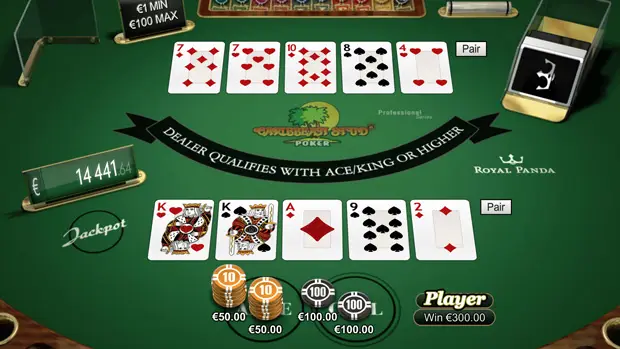
The only decision there is to make at every hand is yours, as the dealer is always set in Caribbean Stud’s ways. You decide, upon having placed an ante and looking at your cards – as well as one of the dealer’s cards – whether to contest the hand or fold. If you decide to fold, you lose the ante. If you want to contest the hand, you have to place a bet to the value of twice the ante. The origins of Caribbean Stud Poker are not really known. There are contrasting stories and allegations typically thrown about in this regard in several online forums and game guides. What is sure is that the game is a relatively contemporary one, with origins in the mid-to-late-1980s and that it’s strongly associated with Aruba, an island country in the Caribbean. Allegedly it was first played here by American tourists on cruise ships headed to Aruba.
It’s not difficult to learn. If you’re confident about your dealt hand, raise by doubling your ante. If you’re not feeling too good about your hand, just fold and forfeit your ante. To win, you must reveal a hand stronger than the dealer’s. But the dealer must qualify to play in the first place and to do this, he must hold an Ace and a King. If he doesn’t, you win at a ratio of 1:1 to your ante, but your raise is pushed back. If the dealer qualifies to play and is beaten, you are paid 1:1 on your ante and a ratio determined by the quality of your hand on your raise. When the dealer wins, you lose both your ante and your raise. The rules to Online Caribbean Stud are quite straightforward, but it is always recommendable to carefully study the rules to any casino game you play. Take a good look at ourfor more in-depth information regarding the game, including gameplay instructions, hand rankings, pay-out ratios and how to win progressive jackpots.
Online Caribbean Stud Strategy
It is always wise to play a casino game with a sound strategy in mind; doing otherwise is rarely profitable and almost always leads to an augmented house edge. Yes, you’ve only got one decision to make when playing Online Caribbean Stud: whether to fold your hand or not. But when is it a good idea to fold? When should you choose to raise and continue? And what of the side bet that’s got to do with the progressive jackpot win?
Please have a look at our page to obtain answers to all of these questions. You may also learn something about the game’s history and the house edge associated with Caribbean Stud Poker there. Some players harp on using complex probability charts to reduce the relatively high house edge typically associated with Caribbean Stud Poker. Remember, however, that basic strategies are straightforward to learn and are, most of the time, just as practical.
Caribbean Stud History
It was first played in Aruba and on cruise ships circling the Caribbean islands. The game was clearly invented with profit in mind, since it has a rather hefty house edge. That said, the game quickly became popular, possibly thanks to the simple rules and the similarities with poker. Other than sharing the five-card hand and same hand ranking as most poker games, the game itself is not really a true poker variation, but more of a blend of poker and casino blackjack thanks to the fact that you play against the dealer instead of other players and there is no bluffing involved. With the popularity of the game growing, it was soon adopted by Las Vegas casinos.
Thanks to the considerable house advantage, Caribbean Stud did not have a huge following when it was first introduced; this led to some casinos adding a progressive jackpot with an optional side bet to attract more players to the game. This version was more widely accepted and is nowadays extremely popular.
Play Online Caribbean Stud Today!
So why not give Online Caribbean Stud a try? It’s a fun, a fast-paced online poker game that is playable for free, with small bets, and even in high-stakes versions. And remember that you’re not playing against other players, so there are no worries about reading faces and figuring out others’ ways. Please explore our site thoroughly, as it contains everything you need to know to up your game and maximize your winnings when playing Online Caribbean Stud. Also, remember that registering at certain through Casino Toplists entitles you to some exclusive player bonuses.